Blog

  • The Impact of Social Media on UI UX Design 2024: What You Need to Know

    Have you noticed how frequently the UI UX design or interface of your favourite social media apps like Instagram, Facebook, Twitter, or Snapchat changes? The continuous changes are somehow frustrating. Still, there are a staggering 4.80 billion active social media users worldwide as of April 2023. According to the research conducted by Datareportal, that’s 59.9% of the total global population.

    The Impact of Social Media on UI UX Design: What You Need to Know

    This is how powerful and influential social media is!

    Just recently, Threads, a ground-breaking social media app launched by Meta in July 2023, skyrocketed to over 100 million users in less than five days solidifying its place as one of the fastest-growing apps in history.

    The impact of social media on our lives is undeniable. It shapes our decisions whether it’s related to our profession, education, passions, or beyond. However, what you may not realize is the profound impact social media has on the world of UI UX design.

    With a new social media app emerging every day and billions of people eagerly signing up, have you ever wondered what makes these platforms so popular? Today, in this article, we’re going to unlock the secrets by exploring the impact of social media on UI/UX design and studying the elements that drive a social media app toward success through its UI UX design strategy. 

    The Importance of UI UX Design for social media success

    Social media and UI UX design are interlinked in deeply with each other and the UI UX design of a social media app plays a significant role in the success of the app. Just look at how Threads performed!

    Within a mere 5 days, Threads with Instagram as its parent app skyrocketed to popularity and the secret behind its rapid success lies in its strikingly familiar interface reminiscent of the widely acclaimed Twitter. Not only does this remarkable app boast a visually reminiscent interface, but its exceptional user experience sets it apart. 

    With a unique offering of allowing users to compose text posts of up to 500 characters, surpassing Twitter’s 250-character limit, it amplifies the power of expression and elevates the overall experience to unprecedented heights. Moreover, you can share photos, videos, and stories with a select group of friends and the app also includes features like disappearing messages and location sharing. The reason of 

    If we analyze, it’s obvious that the factors that contributed to its popularity the most include its focus on privacy, it’s simple design, and its integration with Instagram.

    Back to the frequent design changes that you encounter while using social media apps,  at first glance, these UI/UX design choices may appear perplexing or even frustrating to users. 

    However, it’s important to remember that behind every decision lies a purpose. UI UX design is a continuous and iterative process, and designers meticulously craft their creations with careful consideration and thoughtful intent. They understand that user experience is not solely about immediate gratification but rather about achieving long-term satisfaction and usability. 

    So, while it may be tempting to dismiss certain design elements as annoying, you’ll understand the reasons behind these choices and discover the hidden brilliance that UI/UX designers bring to the table. We will show you in this article how different elements and varying changes in the applications you use add to your experience. Just wait a little bit, we’re about to explain them. 
    the-impact-of-social-media-on-ui-ux-design-2024-what-you-need-to-know-zapta-technologies-articles-blog-post-trends-learning

    How is social media changing UI UX design?

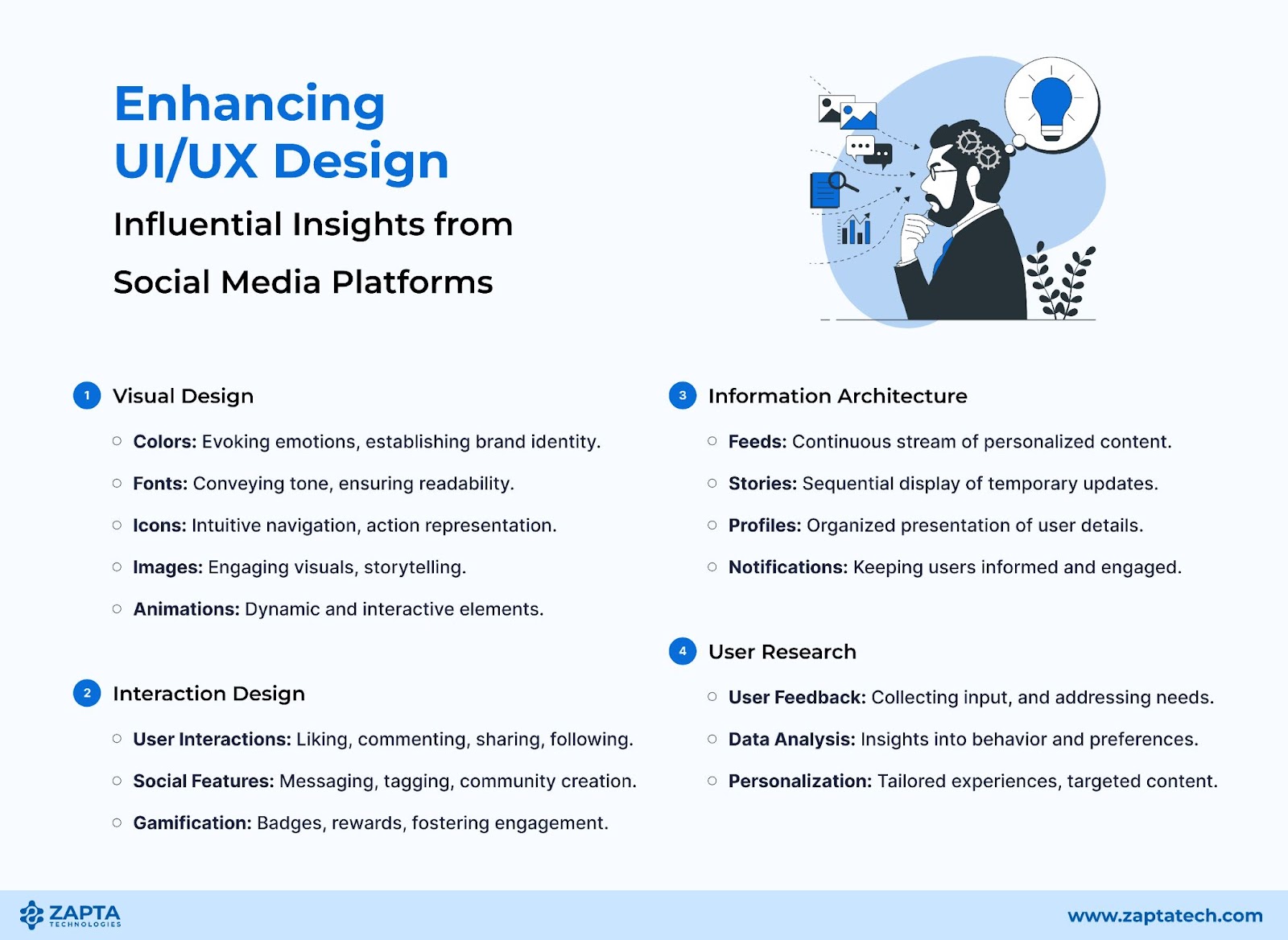
    There are specific aspects of UI UX design that social media significantly influences like visual design, interaction design, information architecture, and user research. For each aspect, we’ll provide you with some examples so you can understand this concept better. Let’s begin;

    Impact of Social Media On Visual Design


    Social media platforms possess attractive and consistent interfaces that engage users and promote brand recognition by using colours, fonts, icons, images, and animations to enhance the user experience and convey their brand identity. This is how social media impacts the visual design of the social media apps you use.

    You must have noticed how each social media platform has a distinct colour scheme. Choosing a specific colour helps it establish a brand identity and creates visual cohesion through its interface, which is also reflected in the customizations users can make when they create a profile picture.

     

  • Top Ranking Among Pakistan’s Software Development Firms on Clutch 2024

    In 2024 ZAPTA Technologies experienced an extraordinary journey marked by a series of wins. We are overjoyed to announce that ZAPTA has earned acclaim for its exceptional services in both IT and User experience Design.  Furthermore, our expertise in development services has been acknowledged, reaffirming our standing in the industry.

    With great pride, we reveal that ZAPTA has been recognized as the Top Laravel Developers in Pakistan for 2024 as well as the Top Java Developers in Pakistan. These prestigious awards have been granted to us by the renowned platform Clutch. 


    ZAPTA Technologies Celebrates Top Ranking Among Pakistan’s Custom Software Development Firms on Clutch

    About ZAPTA Technologies

    ZAPTA Technologies is a leading software design and development company renowned for its expertise in custom software development, web and mobile app development, UI UX design, and various other IT services. What sets ZAPTA apart from its competitors is its strategic service delivery approach. With a steadfast commitment to innovation, client satisfaction, and superior user experiences ZAPTA has been ruling the digital landscape for the past 3 years. 

    Who is Clutch?

    Clutch is a prominent platform among the B2B listing sites that comprehensively evaluates and ranks B2B service providers across various industries. 

    Specializing in showcasing top companies offering IT, marketing design, and development services Clutch has become a trusted resource for businesses seeking reliable partners. Clutch’s rigorous vetting process and commitment to transparency make it a special platform. This helps businesses make informed decisions whenever there’s  a  need for reliable service providers 

    Over the years, Clutch has emerged as a beacon of trust and credibility, guiding businesses toward the most reputable and proficient service providers in the market.

    Well, how clutch reviews a business? Businesses who’ve worked with you can leave a verified review about your services so potential clients can access your expertise and experience in the field. Moreover, you as a service provider can create a detailed profile there to showcase your capabilities, past projects, client testimonials, and more. This matches your profile with the potential partner suiting your services. 

    ZAPTA has been consistently gaining recognition on this platform for its exceptional IT services. This time our development expertise has caught the spotlight adding another feather to our cap. 

    Why ZAPTA Technologies Deserve Recognition For Its Development Services? 

    You might be thinking what makes ZAPTA deserving of this recognition in the Clutch Award? Well, it’s because of their continuous effort, dedication, and commitment to bringing forth the latest technologies in custom software development. Here’s why!

    1. ZAPTA’s team possesses in-depth knowledge and expertise in advanced languages including Laravel and Java to tackle complex projects with confidence. 
    2. ZAPTA stays up to date with the latest advancements in these frameworks which ensures they deliver cutting-edge solutions. 
    3. ZAPTA has a proven track record of delivering high-quality successful Laravel and Java projects which further solidifies our portfolio.
    4. ZAPTA  has its utmost focus on client satisfaction and the positive testimonials we’ve got from them speak volumes about our ability to meet and exceed expectations. 
    5. ZAPTA is about more than just delivering projects but constantly exploring technologies and methodologies that can enhance the efficiency and effectiveness of your software. 
    6. ZAPTA operates on a departmental scale rather than with a small team of developers, allowing us to provide solutions guided by expert consultation and oversight.

    ZAPTA Technologies has established itself as a leader in Laravel and Java development. This Clutch Award recognition is a well-deserved acknowledgment of our dedication to excellence and commitment to delivering exceptional value to our clients.

    Are you looking for a custom software development partner? Feel free to contact us on our website and see what successful projects we have delivered to our clients to get an idea of what we do. Let’s partner up for your next big development project.

  • ZAPTA Technologies is the Top User Experience Company on Clutch 2024

    Unclear buttons, confusing menus, and a clunky user experience can spell disaster for your business. Recognizing this reality early on, ZAPTA Technologies has been steadfast in its commitment to delivering the best digital experiences. 

    Just recently, ZAPTA has been crowned the Top User Experience Company on Clutch across various domains including finance, education, and consumer applications. This prestigious award is a testament to our dedication to crafting interfaces that are visually stunning and incredibly user-friendly as well. 

    However, what sets ZAPTA apart in a fiercely competitive landscape where every company vies for the top spot? 

    Clutch Says We’re the Best: ZAPTA Technologies Is The Top User Experience Company in 2030

    The magic lies in ZAPTA Technologies’ meticulous design thinking process and professional user experience engineers. Here, we consistently place the user at the centre spot, enabling us to build experiences that genuinely resonate. 

    So what’s our topic of discussion today? All about ZAPTA Technologies’ efforts to secure the spot as a top user experience company on the clutch and the strategies behind our success. 

    The Recognition: Clutch Crowns ZAPTA Technologies a UI UX Champion

    Winning in the competitive world of UI UX design is no small feat that too by a well-known platform like Clutch. 

    If you’re unaware, Clutch is a highly respected platform for B2B reviews with clients thoroughly evaluated before leaving feedback. Earning a top spot on their list showcases trust and exceptional service setting ZAPTA apart from the rest. 

    ZAPTA’s success in such varied sectors further highlights versatility and adaptability. Whether it’s building intuitive interfaces for complex financial transactions or creating engaging learning experiences, our design expertise is evident.

    This recognition extends beyond a mere badge of honour and serves as a powerful message for potential clients looking for a UI UX design partner. ZAPTA Technologies are the best for delivering impactful results across diverse industries prioritizing user needs and driving success through intuitive and engaging experiences. 

    Why Are We the Best?

    ZAPTA Technologies is a UI UX design company that combines best of the both worlds which are aesthetics and data. We go beyond what appears upfront and leverage data and user research to create interfaces that are less boring and more functional. Moreover, we give your digital products a human touch by adding the element of empathy and emotional intelligence. 

    We have an exceptional team of experienced UX researchers, visual designers, UX engineers, auditors, usability testers and consultants. They ensure your projects go through all the necessary steps of our design thinking methodology and meet all user expectations. The design thinking process that ZAPTA follows includes several phases including research and domain analysis, user mapping, wireframing, mock-ups, prototyping, and testing. 

    Furthermore, our team follows an agile approach to ensure flexible adaptability to your feedback and results that align with your specified requirements. 

    What Services ZAPTA offers in UI UX design? 

    If you’ve chosen ZAPTA as your UI UX design partner you can avail a comprehensive range of services to design your digital products.  Here’s how our UI UX services can help your business;

    UX Research:

    • Uncovers user needs and pain points, leading to better product decisions.
    • Provides data-driven insights to improve user experience (UX) and usability.
    • Helps validate ideas and identify opportunities for innovation.

    UX Consultation:

    • Offers expert advice on UX strategy and best practices.
    • Helps define product vision and roadmap.
    • Guides specific UX challenges.

    Wireframing:

    • Creates low-fidelity prototypes to iterate and test design concepts quickly.
    • Helps visualize user flows and information architecture.
    • Allows for early stakeholder feedback and collaboration.

    UIUX Design:

    • Creates visually appealing and user-friendly interfaces.
    • Ensures consistent and intuitive user experience across platforms.
    • Contributes to brand identity and differentiation.

    UX Audit:

    • Identifies usability issues and accessibility problems in existing products.
    • Provides recommendations for improvement based on user research and best practices.
    • Helps prioritize fixes and optimize performance.

    Usability Testing:

    • Observe real users interacting with your product.
    • Provides insights into user behaviour and pain points.
    • Helps identify areas for improvement before launch.


    Product Scope:

    • Defines the core features and functionalities of your product.
    • Ensures the product meets user needs and business goals.
    • Helps prioritize development efforts and manage resources effectively.

    Dedicated Designer:

    • Provides ongoing expertise and support throughout the product development process.
    • Ensures consistency and quality in UI and UX design.
    • Builds a deeper understanding of your product and users.

    If you’ve got any of such problems you can reach out to us through our Contact Us form at our website and we’ll schedule a discovery call. ZAPTA technologies with its years of expertise and professional UX experts will build the best digital products for your business that’ll address your business objectives and resonate with your target users alike.

  • The Top 5 Challenges of Cross-Platform App Development 2023

    Businesses constantly evolve in this digital age and seek efficient and cost-effective solutions to reach a wider audience. Cross-platform app development has emerged as a pathway to achieve efficiency and reach without needing separate development for each platform. However, with advantages there also comes some challenges that developers face while developing cross platform applications. 

    This article explores the top five challenges developers face in cross-platform app development, highlighting the complexities and considerations involved.

    Navigating the Future: The Top 5 Challenges of Cross-Platform App Development 2026

    Challenge 1: Compatibility Issues Across Devices

    The primary challenge developers face in cross-platform app development is ensuring compatibility across various devices. With different operating systems and device configurations available, guaranteeing a consistent user experience poses a significant challenge. Each device offers unique capabilities and demands specialized adaptation, from smartphones to tablets, wearables to smart TVs.

    The Complexity of Managing Multiple Operating Systems

    Developers must grapple with the complexities of managing multiple operating systems when creating cross-platform apps. Each operating system, be it iOS, Android, Windows, or others, presents its own set of guidelines and limitations. Balancing the need for consistency while adhering to these platform-specific requirements can be daunting and require meticulous planning and execution.

    Addressing Inconsistent Hardware and Software Performance

    Addressing inconsistent performance becomes crucial as cross-platform apps run on various devices with different hardware and software configurations. Developers must optimize their apps to run smoothly across devices with varying processing power, memory, and storage capabilities. This involves considering load times, resource allocation, and performance optimization techniques to ensure a seamless user experience across platforms.

    Challenge 2: User Experience Design and Adaptability

    User experience (UX) design forms the core of any successful app, and cross-platform development presents unique challenges. Delivering a consistent and seamless experience across different platforms requires balancing aesthetics with functionality.

    Balancing Aesthetics and Functionality Across Platforms

    Developers often face the challenge of striking the right balance between aesthetics and functionality when creating cross-platform apps. While consistent design elements enhance brand identity, the app must adapt to the platform-specific user interface (UI) guidelines. Achieving a visually appealing and intuitive user interface while maintaining the functionality demanded by users is critical.

    Tailoring UI/UX for Different Screen Sizes and Resolutions

    With a wide range of device screen sizes and resolutions available, cross-platform app development necessitates adapting UI/UX elements to ensure optimal user experience. Developers must ensure that their app’s design and layout can seamlessly adapt to the various screen dimensions without compromising usability, readability, or visual appeal.


    Challenge 3: Integrating Native Features and APIs

    One of the primary advantages of cross-platform app development is the ability to leverage native features and APIs to enhance functionality. However, this integration presents its own set of challenges.

    Leveraging Platform-Specific Capabilities in a Unified Environment

    Developers face the challenge of utilizing platform-specific capabilities within a unified cross-platform environment, such as camera access, GPS functionality, or push notifications. This necessitates a thorough understanding and implementation of each platform’s different APIs and libraries, ensuring compatibility across devices.

    Overcoming Limitations and Compatibility Issues with Native APIs

    While integrating native features, developers often encounter limitations and compatibility issues with different native APIs. Each platform has its tools and software development kits (SDKs), and ensuring compatibility across multiple platforms can be arduous. Developers must find creative solutions to overcome these hurdles and provide a consistently functional experience to users across devices.

    Challenge 4: Performance Optimization for Diverse Platforms

    Optimizing app performance across various platforms is critical for delivering a seamless experience to users.

    Optimizing App Performance without Sacrificing User Experience

    Developers face the challenge of optimizing app performance without sacrificing the user experience. This requires thorough testing and benchmarking across devices with varying processing power and memory capacities to ensure the app performs optimally while maintaining its desired functionality and responsiveness.

    Mitigating Performance Variations Across Platforms and Devices

    Performance variations are inevitable as apps are used on devices with different hardware specifications. Developers must proactively address these performance differences, utilizing techniques like adaptive resource allocation, caching, and intelligent content loading to minimize disparities and deliver a consistent experience, regardless of the user’s chosen platform.

    Challenge 5: Debugging and Maintenance across Platforms

    Maintaining a high-quality app requires effective debugging and regular updates across all platforms.

    Troubleshooting Errors and Bugs in a Multi-Platform Setup

    With cross-platform apps running on multiple operating systems, identifying and troubleshooting errors and bugs can be complex and time-consuming. Developers must adopt efficient debugging practices and utilize specialized tools to resolve issues and promptly ensure optimal app performance across platforms.

    Ensuring Consistent Updates and Maintenance for All Platforms

    To keep up with evolving platforms, developers must ensure consistent updates and maintenance for all devices, requiring careful planning and synchronization across different app stores and platforms. Continuous testing, bug fixing, and feature updates are crucial to provide an enjoyable and secure user experience.

    Conclusion

    While cross-platform app development presents significant challenges, its efficiency and reach rewards are undeniable. By navigating the complexities of compatibility, developers can unlock the potential of cross-platform app development and provide users with rich and consistent experiences across multiple devices. By embracing these challenges head-on, businesses can position themselves at the forefront of the rapidly evolving digital landscape.

  • The Best Web Development Tools for 2023

    If you’re a web developer, staying ahead of the curve isn’t an aspiration; it has become necessary. The digital landscape of 2023 continuously shifts its dynamic and presents developers with unprecedented opportunities and challenges. 

    Therefore, having the right tools in your arsenal is crucial to empower you to conjure digital experiences. Whether you’re a seasoned developer or someone taking their first steps into coding, the tools you employ can make all the difference. So, Picture this article as your treasure map, guiding you through the collection of 2023’s best web development tools.

    Having these tools would unlock the doors to efficiency, creativity, and the art of digital craftsmanship.

    Top web development tools for 2023

    Discover these top-tier tools that, once mastered, have the potential to elevate your expertise as a developer to unprecedented heights.

    Sublime Text

    Sublime Text is a popular code editor among developers as it is an essential tool that streamlines the coding process, enhances productivity and improves the overall development experience. You can experience the best speed, flexibility and customizability with Sublime Text’s editor. 

    Developers like it because it’s a fast and efficient tool in functionality and works smoothly even when dealing with large files. If you need to finish your work quickly and effectively, the sublime Text is for you. In addition, you can easily change the look and feel of your editor and customize it as you like. You can add new features and functionality through plugins, which adds to the overall experience. 

    The good news about sublime Text is it supports a huge range of programming languages, including HTML, CSS, JavaScript, PHP, Python, and Java. This makes it a good choice for developers who work with multiple languages.

    Lastly, Sublime Text is a powerful, versatile, free, open-source software. This means it is free to use and modify, and the source code is available for everyone to see.

    Jest

    Testing software and fixing bugs is often a frustrating task for developers. However, with Jest, a testing framework used for testing the functionality of web applications, you can rest assured. It is a popular choice for unit testing as it is easy to use and a fast and efficient option when working with large test suites. If you’re a beginner, the syntax will never be a problem for you, and plenty of resources are available to help developers get started with Jest. 

    Regarding flexibility, you can use Jest for a wide range of JavaScript code because it supports both unit testing and interaction testing and can be used to test any style of written code. Furthermore, several plugins are available that can further enhance the functionality and features of Jest. 

    With Jest, developers can generate coverage reports showing which parts of the code have been tested. This can help developers identify code areas that need more testing. Similarly, it supports snapshot testing that developers can use to compare the output of a test to a known good state. This can help identify code changes that have caused unexpected behavior.

    Postman

    Postman is another incredible tool for developers to test and develop APIs, send and receive requests and responses and view the response data in a structured way. You can use it to ensure your APIs work as expected and return correct data by sending API requests and verifying responses. 

    Moreover, it allows you to experiment with different API parameters and debug API code, which gives you an edge in developing new APIs.  

    Postman will be your favorite tool as it can be used to document APIs by creating and sharing collections of requests and responses. This can help you understand how to use APIs, and you can share your knowledge and the API documentation with others.

    Since 2023 is the era of automated technology, Postman will help you automate API testing by creating and running test scripts. You can save your time and ensure that APIs are tested regularly.

    Overall, Postman is a powerful and versatile tool that can be used for various APIs-related tasks. It is a valuable tool for any developer who works with APIs.

    Docker

    Docker, a powerful and versatile containerization tool, can be used for various application development and deployment tasks. As a developer, you can use Docker to build and deploy applications by creating containers. The container will also package the application code, dependencies, and runtime environment. Docker is here to ease application deployment to different settings and scale applications up or down as needed.

    If you want to store your applications in different containers, you can do so. This will prevent one application from affecting the other one. You can even manage the dependencies to ensure that the application always has the correct dependencies, regardless of the environment in which it is deployed. Additionally, you can deploy security features such as encryption and authentication using Docker to protect applications from unauthorized access and malicious attacks.

    The possibilities are endless with Docker since you get so many features within a single tool. A curious mind is needed to explore it to its full potential. 

    Webpack

    Webpack remains the go-to choice for bundling and managing complex front-end assets in 2023 for developers. You employ Webpack to streamline the deployment of modern web applications by intelligently bundling JavaScript, CSS, and various holdings into optimized bundles. Through the integration of loaders and plugins, developers effortlessly transform and optimize their codebase, enabling support for cutting-edge technologies like ES6+, TypeScript, and CSS preprocessors. 

    Furthermore, the rise of micro-frontends and component-based architectures is seamlessly facilitated by Webpack’s code-splitting capabilities, enabling developers to create dynamic, efficient, and modular web experiences. In a world where performance and optimization are paramount, Webpack can be used by developers to deliver highly performant and user-friendly applications through its refined bundling techniques and efficient workflows.

    Final thoughts 

    So these are the top 5 tools developers must explore in 2023 to grow their skills and expertise in the competitive market. Being a developer, mastering new tools directly translates to staying relevant and effective in your roles. With these tools, you can bring enhanced efficiency, improved workflows, and better outcomes. 

    Additionally, by learning these tools, you can unlock fresh ways of problem-solving, streamline your development processes, and even discover novel creative avenues. Staying adaptable by learning new tools also fosters professional growth, making developers more valuable assets to teams and organizations. 

  • How to Test Your Software Effectively? A Developer’s Guide 2023

    Have you ever wondered why some software applications work flawlessly while others are riddled with bugs and glitches? Imagine eagerly awaiting the launch of a highly anticipated app, only to find that it’s full of issues, and your excitement turns to frustration. We’ve all been there, right?

    In software development, testing is the safety net that ensures your application meets user expectations, functions as intended, and operates without hiccups. Neglecting effective testing can result in costly setbacks, tarnished reputations, and disgruntled users.

    This blog post will explore essential strategies and best practices to help you test your software effectively. Whether you’re a seasoned developer or just starting in the field, you’ll find valuable insights to improve your software testing processes.

    We’ll delve into various aspects of software testing, including test planning, types of testing, automation, and best practices for ensuring your software is not only bug-free but also performs optimally.

    But before diving into the nitty-gritty of software testing, let’s start at the beginning: understanding the importance of test planning and strategy.

    How to Test Your Software Effectively? A Developer’s Guide 2023

    Understanding Software Testing and Why It Matters? 

    When developers build software, it gets tested to ensure it works as intended and has no bugs or glitches. You can think of it as trying out a video game to see if it has any problems like characters getting stuck or the game crashing. Testing helps find and fix these issues before many people use the software.

    The reason why software testing matters to developers is simple. You want your software to function properly and not misbehave when people use it. It helps you identify and fix problems early and saves time and money. Additionally, It ensures users have a better experience with the software and trust that it will work as expected. 

    Thus, software testing is like quality control for computer programs, making them reliable and safe for everyone to use.

    What Is The Software Testing Process?

    You have to follow five steps if you want to conduct software testing effectively;

    Test planning: In this step, you must figure out the part of the software you want to test and the kind of test methodology you’ll be using. And the resources you’ll need to do so. It will be a testing to-do list where you plan to ensure everything gets tested thoroughly. 

    Test design: You create detailed test cases with instructions for testing each part of your software. The test design or cases are step-by-step instructions to check if the software works correctly.

    Test execution: This time, you run the tests you’ve designed in the previous stage. You’ll use the test cases in this step to see if your software is working as it should by clicking buttons, entering data and observing its behavior. 

    Bug tracking and management: Here, you document any bug or error encountered while testing. You describe what went wrong and how to reproduce the problem so developers can fix it later.

    Test reporting: A documented version of the test conducted summarizes what tests you ran, what issues you found, and how severe they are. It helps everyone involved understand the state of the software and what still needs to be fixed or tested.

    Types of Software Testing

    If you are just starting, you may be confused about the software testing methods available. Here is the breakdown of various software testing you can conduct 

    There are two main approaches used for software testing: manual and automated. Which method should you choose? The choice between manual and automatic testing depends on various factors including the project’s requirements, budget, timeline, and the nature of the software being developed.

    Manual testing may be more cost-effective for small or short-term projects than setting up an automated testing infrastructure. On the other hand, you can integrate automated testing in the CI/CD pipeline for rapid feedback during the development process.

    In practice, many projects use a combination of manual and automated testing to leverage the strengths of both approaches. The choice between the two methods should be based on the project’s specific needs and constraints.

    The common testing methods that you can use are listed below;

    Unit testing: (for conducting tests on individual components or functions of software)

    Integration testing: (to see if different components of the software work seamlessly together or not)

    Functional testing: (to see if the software is working as specified in requirements)

    User interface: (UI) testing: (To audit the graphical user interface for usability, aesthetics, and functionality.)

    Performance testing: (to test the software’s functionality under different conditions, like load, stress or scalability)

    Security testing: (to identify security issues, weaknesses and vulnerabilities)

    Each type of testing serves a specific purpose in the software development lifecycle and helps ensure that the software meets its quality and functionality requirements. Depending on the project’s needs, one or more of these testing types may be conducted.

    Best Practices For Software Testing

    If you want to effectively conduct software testing and get the desired results out of it, follow these best practices;

    • Start testing as early as possible in the development cycle so you can catch issues early on and fix them at a low cost.
    • Understand the software requirements beforehand, which will be the basis for test case development and validation. 
    • Go into detail while creating test cases and outline what will be tested, how it will be tested, and what success criteria will be used. This helps in ensuring that all aspects of the software are covered.
    • Use automation to minimize redundancy wherever possible.to save time, reduce human error, and provide quick feedback on code changes. 
    • Don’t rely solely on one type of testing. Incorporate various testing types such as unit testing, integration testing, functional testing, performance testing, security testing, and usability testing. Each type of testing serves a different purpose in verifying the software’s quality.
    • Create realistic and diverse test data to simulate different usage scenarios. Test data generation tools can help you generate data for other test cases.

    Follow the above-mentioned best practices to ensure your software works flawlessly for users. 

    Last Thoughts

    In closing, software testing is the bridge that connects development with the end-users, ensuring that the final product is a reliable, secure, and efficient solution. By adhering to these best practices and fostering a culture of quality, developers can confidently navigate the complexities of modern software development, knowing that their creations will stand the test of time and technology.

  • Building Strong Business Relationships for Sustainable Growth

    Research consistently highlights the immense value of customer retention, showing that increasing retention rates by just 5% can lead to significant boosts in overall profitability.

    Furthermore, studies across the business sector reveal that a small shift in retaining your existing customer base can yield anywhere from a 25% to 95% increase in profits. 

    Building Strong realation with USAMA NADEEM

    However, how do you retain these customers and grow your business? The answer lies in the magic word: “networking” and strategies that help in fostering long-term relationships with your partners, customers, and clients.  Therefore, we’ve brought you this article where we’ll help you understand how you can build strong business relationships for sustainable growth. You’ll also learn some strategies to retain your customers and engage them so let’s get started.  

    How to build strong business relationships with business partners?

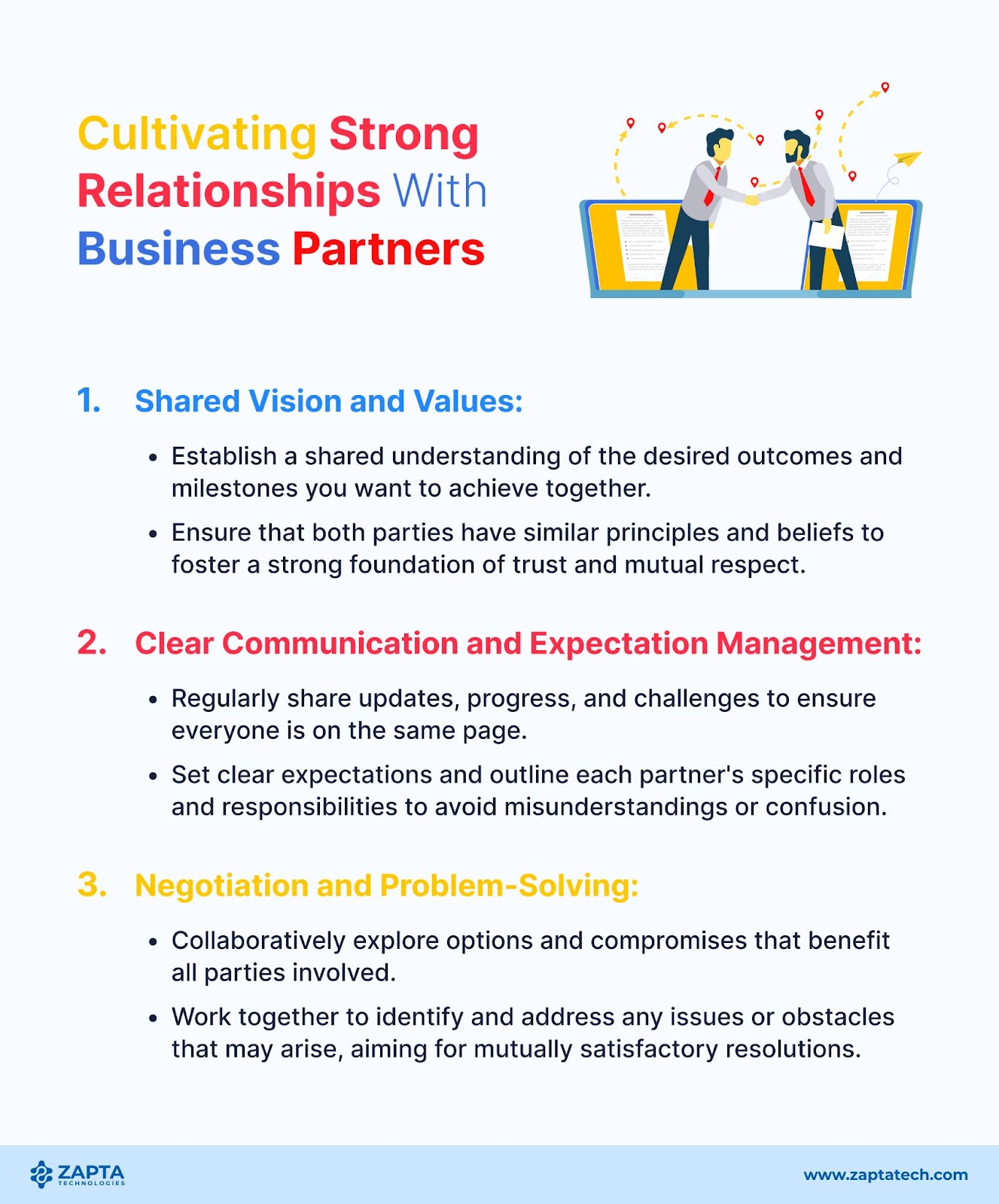
    If you are an entrepreneur, a business owner, or a CEO it’s common to find yourself pondering the following question. How to maintain strong business relationships? Well, the answer is dependent on many crucial factors like shared vision, clear communication, negotiations, and collaborative problem-solving skills. 

    Cultivating strong business partner relationships is an essential aspect of running a successful business. It involves developing and maintaining connections with other peers and organizations to achieve mutual success and promote growth. Let’s explore these factors to have a deeper understanding of business partner relationships.

    Having a shared vision and values

    When you’re seeking out business partners, it’s essential to look for those businesses that share the same vision, goals, and values as you. Having a shared vision creates a sense of common purpose that enables business partners to work together towards a common objective. When partners have aligned business goals and values they are more likely to approach business decisions and practices in a compatible and harmonious manner. Having such an alignment lays the foundation for strong and long-term business relationships and fosters trust and mutual respect as partners recognize each other’s commitment to the shared vision and values.

    Clear communication and expectation management

    Effective communication and expectation management are vital for any relationship to establish open and transparent communication channels. By doing so you will facilitate smooth interaction and avoid misunderstandings that can create problems in business. However, if you have clear communication channels it will ensure that both parties are on the same page regarding objectives, strategies, changes, and development that can arise while operating the business. You can work promptly and together to address the challenges that may arise in the future. 

    What more, expectations management is a crucial aspect of business that you need to learn to prevent conflicts and disappointments. Clearly defining and managing expectations from the outset helps avoid misunderstandings and ensures that both parties have a realistic understanding of what can be achieved. This involves setting clear deliverables, timelines, and key performance indicators (KPIs). Regularly reviewing and revisiting these expectations throughout the partnership helps maintain alignment and adapt to evolving circumstances.

    Negotiation and problem-solving

    If you want to build successful business partner relationships you need to build a foundation based on mutual benefit. The primary focus should be on finding a win-win solution that satisfies the interest of both partners. By following this approach you can foster goodwill and a sense of fairness, enhancing the overall relationship. Collaborative problem-solving is another important aspect of relationship cultivation. When challenges or conflicts arise, partners should work together to identify the root causes and explore creative solutions. This collaborative approach not only resolves immediate issues but also strengthens the bond between partners and builds trust.

    Next, we’re sharing some of the best strategies you can follow to build strong business relationships and eventually grow your business. 

    building-strong-business-relationships-for-sustainable-growth-zapta-technologies


    Strategies for building strong business relationships

    Before we start with the strategies, it’s essential to understand that building strong business relationships involves combining interpersonal skills, effective communication, trust-building techniques, and a customer-centric approach. 

    So let’s begin with the strategies.

    Establish trust:

    The primary factor that plays a crucial in building and running a successful business is establishing trust and reliability among your partners your clients and your customers. To establish trust and reliability you must set realistic expectations about your business, products, and services and then follow through on your commitments. 

    Moreover, deliver your products and services as promised and on time. If some unseen circumstances occur, it’s best to approach them proactively and communicate them well. You can’t go wrong with this one because if you’re not sharing your problems clearly with your audience, it can create misunderstandings and you can harm your reputation. Honesty, fairness, and ethical principles are what make a business maintain its overall integrity and conduct.

    Foster communication:

    What’s a business that doesn’t listen to its audience? Businesses run only when they solve a problem. However, if a business is not understanding the needs of its customers, their pain points, and the target market then, you need to work hard. What you can do is listen actively to your audience and their concerns about your business.

    Communicate with them when there’s a problem and address them through appropriate channels. Engage them continuously through social media platforms so they can understand your business better. Furthermore, it’s essential to get their feedback so you can address their concerns promptly.

    Cultivate respect:

    Having mutual respect among partners and customers also fosters long-term business relationships. To achieve this you have to recognize, value, and appreciate what each party brings to the relationship. show empathy towards your partners and customers by understanding and considering their challenges, perspectives, and goals. By validating their opinions you can make them feel that they are being listened to and understood and they’ll respect and trust you more with your services or products.

    Be customer-centric:

    Personalization always makes wonders when it comes to business. By focusing on personalized experiences and having a customer-centric approach you can make your customer believe in your products more and more. Tailor your products and services to meet the specific needs of your customers. In addition, you can gather data and insights to understand their preferences and behaviours, which will give you an idea of how to improve your products and services.

    For example, if you are a Software as a Service (SaaS) business then you can provide personalized training to your customers to understand and utilize the software features and functionalities. By doing so you not only build trust but also establish yourself as a thought leader in industry. 

    Seek feedback:

    Maintaining continuous engagement and seeking feedback is a vital practice in building strong business relationships. It involves actively connecting with partners or customers through various channels and consistently seeking their opinions and insights. By regularly engaging with them through newsletters, social media platforms, and other communication channels, businesses can keep them informed and connected.

    Actively soliciting feedback on products, services, and overall experiences demonstrates a commitment to understanding their needs and preferences. Acting on the feedback received, whether through product improvements, process enhancements, or customer service adjustments, shows that their input is valued and contributes to the continuous improvement of the business. This ongoing engagement and feedback loop not only fosters trust and loyalty but also helps businesses stay relevant and customer-centric in a rapidly evolving marketplace.

    For example, if you are an e-commerce retailer you can actively engage with your customers through channels like email newsletters, social media platforms (Facebook, Instagram, Twitter), and a blog. It will help them get to know your business better and establish transparency and trust. 

    Final thoughts

    In a nutshell, building long-term relationships with business partners and for a sustainable business is essential to keep customers and their needs at the forefront. When you understand your target audience, and their problems you can build tailored solutions that appeal to their challenges and solve them. Moreover, respecting your partners and engaging them throughout your business operations make them feel seen and validated which also enhances long-term relationships. It’s all about active listening and observing what the customers and partners demand.

  • How to Choose the Right Cross-Platform App Development Framework 2023?

    Mobile applications are becoming prevalent and a crucial aspect of the digital world. For business, entertainment, or personal use, apps have digitized everything. Since multiple platforms are available, developers often face the challenge of building apps that can run seamlessly across different operating systems like iOS and Android. This is where cross-platform app development comes into play.

    Choosing the right cross-platform app development framework is crucial for developers to ensure the success of their projects. It saves time and effort and provides a consistent user experience across multiple platforms. 

    This guide will take you through the essentials of choosing the right cross-platform app development framework, considering current industry trends and modern technologies.

    The Ultimate Guide to Choosing the Right Cross-Platform App Development Framework

    Understanding Cross-Platform App Development

    Cross-platform app development means developing mobile applications that can run on various operating systems but using a single codebase. You only have to write the code once, and then you can deploy it on multiple platforms, saving time and resources.

    The advantages of cross-platform app development are numerous. Firstly, it offers cost-effectiveness as it doesn’t require developing separate apps for each platform. Secondly, it provides faster development cycles, as developers can work on a single codebase instead of multiple ones. Lastly, it ensures a consistent user experience across platforms, enhancing user satisfaction.

    Key Factors to Consider

    Several key factors must be considered when choosing a cross-platform app development framework. These include:

    Performance and Speed: The framework should provide excellent performance and speed, ensuring smooth app operation across platforms.

    Ease of Development and Learning Curve: The framework should be developer-friendly, with a shallow learning curve, allowing developers to adapt and build apps efficiently and quickly.

    UI/UX Capabilities and Customization Options: The framework should provide extensive UI/UX capabilities, allowing developers to create visually appealing and highly customizable app interfaces.

    Community Support and Developer Ecosystem: A strong community of developers and active support from the framework’s creators are essential for troubleshooting issues and getting timely updates.

    The Evolution of Cross-Platform App Development Frameworks

    To make an informed decision about choosing the right cross-platform app development framework, it’s crucial to understand the evolution of popular frameworks in the past and the current trends in the industry.

    Overview of Popular Frameworks in the Past

    In the early days of cross-platform app development, frameworks like PhoneGap and Appcelerator Titanium gained popularity. These frameworks allowed developers to build apps using web technologies like HTML, CSS, and JavaScript. However, they had limitations in terms of performance and native feature support.

    As technology advanced, new frameworks like React Native and Xamarin emerged. React Native, developed by Facebook, gained popularity due to its ability to build native-like apps using JavaScript. Xamarin, on the other hand, allowed developers to write code in C# and build native apps for multiple platforms.

    Current Trends and Emerging Technologies

    In recent years, the cross-platform app development landscape has witnessed significant advancements. Flutter, developed by Google, has gained widespread adoption due to its fast rendering engine and the ability to create visually appealing and highly performant apps. Flutter uses Dart, a language designed for building user interfaces, making it a powerful choice for developers.

    Another emerging technology is Kotlin Multiplatform, which allows developers to share code between different platforms, including iOS and Android, using Kotlin. Kotlin Multiplatform is gaining momentum due to its seamless integration with existing Kotlin codebases.

    Web-based frameworks like React Native and Ionic have evolved and improved, providing better performance and native features support.

    Evaluating Your App Development Needs

    Before diving into the different cross-platform app development frameworks, evaluating your app development needs is crucial.

    Project Requirements and Goals

    Identify the specific requirements and goals of your app project. Consider the application’s complexity, the need for native functionalities, and the target market.

    Target Audience Analysis

    Selecting the right framework requires understanding your target audience and their preferences. Analyze the platforms most commonly used by your target audience and ensure compatibility with those platforms.

    Platform Compatibility Considerations

    Consider the compatibility of the frameworks with the platforms you intend to target. Some frameworks may have limitations or better support for specific platforms, impacting your development process. 

    Key Factors in Choosing the Right Framework

    When evaluating the different frameworks, several key factors should be considered.

    Performance and Speed Considerations

    Ensure that your chosen framework provides excellent performance and speed across multiple platforms. Look for frameworks that offer native-like performance and optimize rendering.

    Ease of Development and Learning Curve

    Consider the learning curve of each framework and evaluate how easily your development team can adapt to it. Look for frameworks with extensive documentation, tutorials, and a supportive community.

    UI/UX Capabilities and Customization Options

    Evaluate the UI/UX capabilities of each framework and the level of customization it offers. Consider the design requirements of your app and choose a framework that aligns with your vision.

    Community Support and Developer Ecosystem

    Consider the developer community’s size and activity for each framework. Look for frameworks with vibrant communities that offer regular updates, bug fixes, and new features.

    Best Practices in Cross-Platform App Development

    Here are some best practices for successfully launching your cross-platform app development projects.

    Code Reusability and Scalability

    Implement code reusability by creating modular components that can be used across platforms. This reduces development time and effort. Additionally, design your app architecture with scalability, allowing for easy future updates and feature additions.

    Testing and Debugging Strategies

    Implement thorough testing strategies to ensure the reliability and compatibility of your app across platforms. Use emulators and real devices for testing, and consider automated testing tools to streamline the process. Implement effective debugging strategies to identify and fix issues quickly.

    Optimizing App Performance for Different Platforms

    Optimize your app’s performance by leveraging platform-specific optimizations. Consider factors such as memory management, network efficiency, and performance profiling. Regularly monitor and fine-tune your app’s performance to provide a smooth user experience.

    Future Trends and Predictions

    As we look towards the future, several emerging technologies in cross-platform app development are worth watching.

    Emerging Technologies in Cross-Platform App Development

    Progressive Web Apps (PWAs) are gaining traction due to their ability to provide app-like experiences through web browsers. PWAs leverage modern web technologies to deliver a fast and engaging user experience.

    Augmented Reality (AR) and Virtual Reality (VR) are also expected to shape the future of cross-platform app development. These immersive technologies offer new possibilities for app development, particularly in areas such as gaming, education, and training.

    Expected Advancements in Frameworks

    Flutter and Kotlin Multiplatform continue to mature and evolve, offering enhanced performance, stability, and feature support. Additionally, we can expect frameworks to become more interconnected, allowing developers to integrate different technologies into their cross-platform apps seamlessly.

    Conclusion

    Choosing the right cross-platform app development framework is a crucial decision for developers. It requires carefully evaluating project requirements, target audience, and available frameworks. When you consider factors such as performance, ease of development, UI/UX capabilities, and community support, you’ll make an informed decision aligning with your project goals.

    As cross-platform app development evolves, staying abreast of current trends, embracing best practices, and exploring emerging technologies will be vital for developers to create successful and future-proof mobile applications.

    Remember, a well-chosen framework can streamline your development process and provide a consistent user experience across platforms, setting your app up for success in a competitive digital landscape.

Transform Your Business with Smart Technology

We build modern digital solutions designed to solve real business problems and improve everyday operations.

Our Services

Web Development

We create fast, responsive websites built around your business goals and customer needs. From simple company websites to complex web applications, our development team delivers reliable solutions.

AI Solutions

Our AI solutions include intelligent automation and AI-powered applications that help businesses save time and make better decisions.

Digital Marketing

Grow your online presence with data-driven marketing strategies focused on visibility, engagement, and measurable results.

Why Choose Us?

We combine technology, creativity, and strategic thinking to deliver solutions that create long-term value.

Our process is simple. We understand your needs, plan the right solution, and deliver results.

About Our Company

We are a technology company focused on helping businesses succeed in the digital world. Our team works closely with clients from the initial idea to the final implementation to ensure every project meets its goals.

Contact Us

Have a project in mind or need help improving your existing digital presence? Contact our team today and let’s discuss how we can help your business grow.